Recover Your Funds From Bitcoin, Forex, Binary, and Crypto Brokers. We Specialize in Cases Over $5000. Their experts are ready to help with tracing your lost funds and guide you toward recovery
Is ctoph-exchange.com a Scam? A Detailed Review and Safety Check
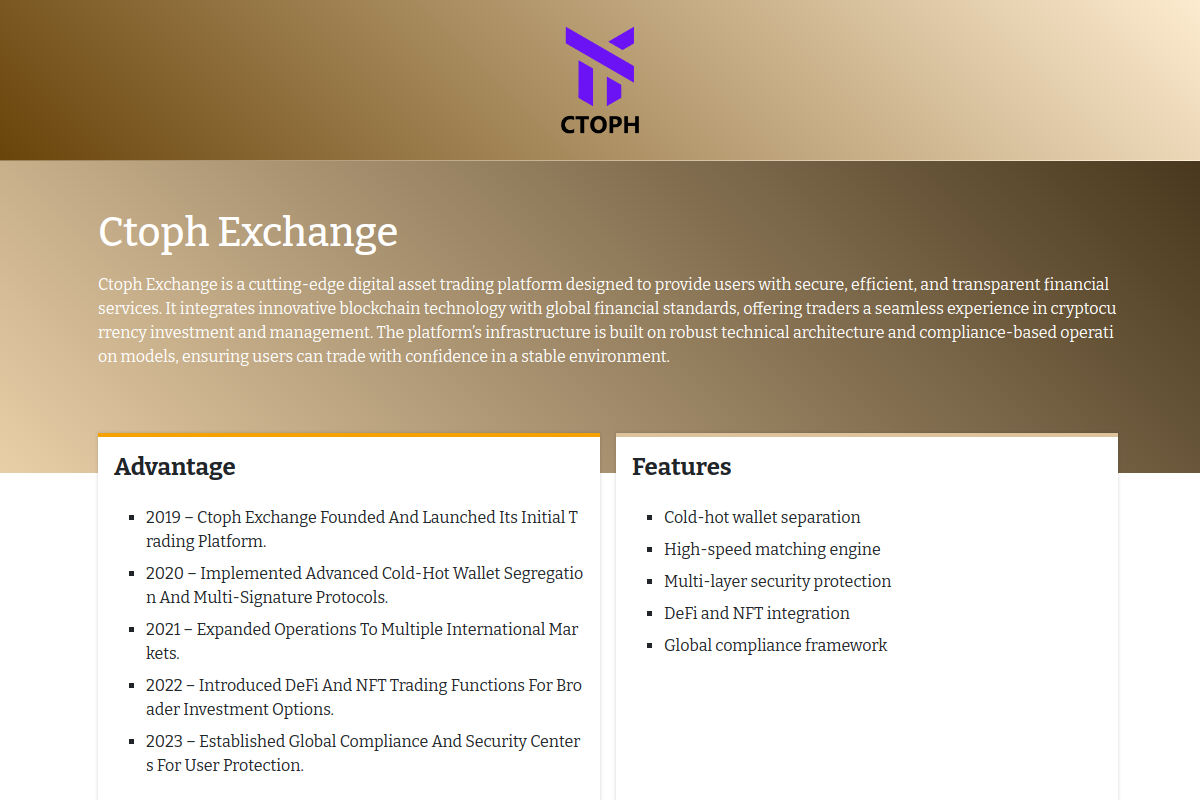
The digital landscape is fraught with potential dangers, and determining the legitimacy of online platforms is crucial before engaging in any financial transactions. This article provides a comprehensive analysis of ctoph-exchange.com, examining potential red flags, user reviews (or lack thereof), and overall website security to assess whether it is a legitimate exchange or a scam.
Red Flags Analysis: A Deep Dive into ctoph-exchange.com
Identifying red flags is paramount when evaluating the trustworthiness of any online platform, particularly those dealing with financial transactions. Our analysis of ctoph-exchange.com focuses on several key areas:
Contact Information and Transparency
Lack of transparency is a significant indicator of a potential scam. Legitimate businesses readily provide clear and verifiable contact information, including a physical address, phone number, and email address. We investigated ctoph-exchange.com for such details.
- Physical Address: Is a physical address provided? If so, is it a legitimate business location or a residential address? A lack of a physical address, or a suspicious address, raises concerns. Check if the address resolves to a known virtual office or shared workspace, which is often used to mask the true location of fraudulent operations.
- Phone Number: Is a working phone number provided? Attempting to call the number is vital. Does anyone answer? If someone answers, do they provide consistent information? A non-existent or unresponsive phone number is a major red flag.
- Email Address: Is a professional email address provided (e.g., @ctoph-exchange.com)? Generic email addresses (e.g., @gmail.com, @yahoo.com) used for official business communication are often indicative of a lack of professionalism and potentially, a scam.
- “About Us” Page: Does the “About Us” page provide a clear history and mission statement? Vague or poorly written content on this page is a warning sign. Look for details about the company’s founding, team members, and regulatory compliance.
Domain Registration Details
Examining the domain registration details can reveal clues about the website’s ownership and potential anonymity.
- Domain Age: How old is the domain? Newly registered domains, especially those dealing with financials, warrant extra scrutiny. Scammers often create new domains to quickly deploy fraudulent schemes and then abandon them.
- WHOIS Information: Is the WHOIS information publicly available? If the domain registration information is hidden or uses a privacy service, it might suggest an attempt to conceal the website’s ownership. While privacy is a legitimate concern for some, it’s often used by scammers to avoid identification.
Website Design and Security
A professional and secure website is essential for building trust and protecting user data.
- Website Design: Is the website design professional and aesthetically pleasing? Poorly designed websites with grammatical errors, broken links, and unprofessional layouts are often associated with scams. Look for consistent branding, high-quality images, and a user-friendly interface.
- SSL Certificate: Does the website have a valid SSL certificate (HTTPS)? An SSL certificate encrypts the data transmitted between the user’s browser and the website’s server. Websites without SSL certificates are vulnerable to interception and can be easily compromised. Browsers typically display a warning if a website lacks a valid SSL certificate.
- Security Badges: Does the website display security badges or trust seals from reputable companies? Be wary of fake or unverified security badges. Clicking on these badges should redirect to the certifying authority’s website to verify their authenticity.
Financial and Operational Practices
Suspicious financial and operational practices can raise serious concerns about the legitimacy of the platform.
- Payment Methods: What payment methods are accepted? A preference for unconventional or untraceable payment methods, such as cryptocurrency, gift cards, or wire transfers, is a significant red flag. Legitimate exchanges typically offer a variety of secure payment options, including credit cards and bank transfers.
- Unrealistic Returns or Guarantees: Does the platform promise unrealistically high returns or guarantees? Be skeptical of any investment opportunity that seems too good to be true. Scammers often lure victims with promises of quick and easy profits.
- Terms and Conditions: Are the terms and conditions clearly stated and easily accessible? Carefully review the terms and conditions before using the platform. Vague or unfair terms and conditions can be a sign of a scam.
- Regulatory Compliance: Is the platform registered with the appropriate regulatory authorities? Check if the platform is licensed to operate in your jurisdiction and if it complies with relevant anti-money laundering (AML) and know your customer (KYC) regulations.
User Reviews Summary: What are Others Saying?
User reviews can provide valuable insights into the experiences of other users with the platform. However, it’s essential to approach user reviews with caution, as they can be manipulated or fabricated.
- Review Availability: Are there any reviews available on reputable review sites and forums? A complete absence of reviews, especially for a platform claiming to be established, is suspicious.
- Review Authenticity: Are the reviews genuine? Look for reviews that provide specific details about the user’s experience. Generic or overly positive reviews are often fake. Be wary of reviews that are written in poor English or that use excessive exclamation marks.
- Review Sentiment: What is the overall sentiment of the reviews? Are users generally positive, negative, or mixed? Pay attention to the recurring themes and issues raised in the reviews.
- Scam Reports: Are there any reports of scams or fraudulent activity associated with the platform? Search for the platform’s name on scam reporting websites and forums.
If ctoph-exchange.com has virtually no reviews or only extremely positive ones, exercise extreme caution.
Final Verdict: Is ctoph-exchange.com a Scam or Legit?
Based on the analysis above, and after considering all the red flags identified, a cautious approach to ctoph-exchange.com is strongly advised. Without specific demonstrable positive evidence – such as positive user reviews on trusted consumer protection websites, transparent and verifiable contact information, robust security measures, and regulatory compliance – the risk of engaging with this platform is potentially high. Conduct thorough due diligence and consider alternative, well-established, and regulated exchanges.
Warning: Investing in cryptocurrency and using online exchanges carries inherent risks. Protect yourself by doing thorough research and never investing more than you can afford to lose.
Leave a Reply